There is a question often asked when traveling; where are you from? As we spend most of days outdoor, I am thoroughly tanned, disguising my identity as a thin, pale Japanese man. while in Mongolia, locals more than often came to me with their native tongue, and when I shake my head as I point at myself and say "Japon", they continue to speak in Mongolian as if to say I am lying. I tilt my head with an uncomprehending expression, they would then say "ahh, yakuza"... No one really believes where I am from here in China either, and popular assumption is often Korean and Mongolian. The most unusual was when I was called a Himalayan in Iceland.
Sahe is usually mistaken by Chinese locals that she is one of them, or Tiwanese. However, this misunderstanding is usually followed by "because your Chinese is excellent", so it's a good thing, unlike mine. In a town of Shan Shan we went to get a room in a motel turned out to be not available for a foreigner, the clerk told Sahe they have a room available but asked who the man standing next to her is. I guess I don't pass as one of them.
tear it down / build it up (leaving Yokohama together, to start a new life in New York together)
8.22.2011
8.15.2011
Beer in Mongolia
Leaving Ulaanbaatar
The train rolls out quietly. The late sunset coated the small village with a gradation of dusty gold. Three weeks ago we saw a similar view out the window of an arriving train, but it was more or so like a postcard. We can now see through walls to imagine children running around and through ger to picture mother preparing a meal by the stove.
We woke up in the morning to an open desert; Gobi. Within our limited vision through an endless land, there is an ger, alone like a spaceship that just landed on an inhabited planet. I quietly sent a thanks for the past three weeks, and only then my expectation slowly raised its head out of a vow as we came closer to the border of our next country unknown.
Camping in a steppe
Due to internet restriction, some blog entries date back as far as 20 days.
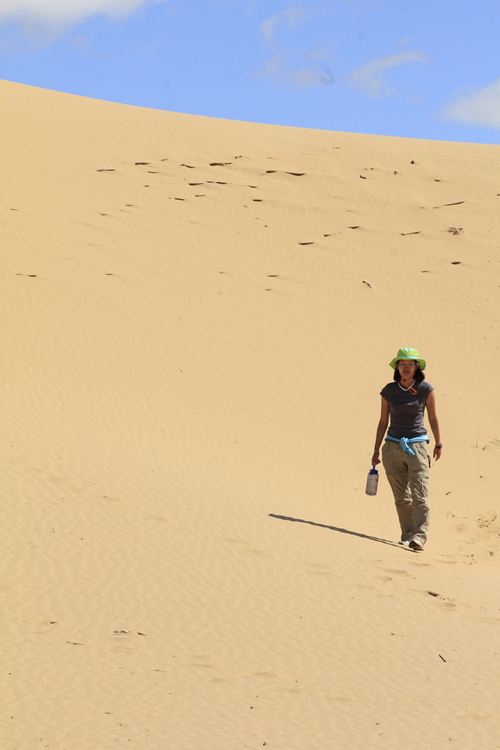
The scenery slowly changes from steppe to highlands, from mountains to valleys. I spent most of the full-day drive sleeping, exhausted from past few sleepless days. We arrived to Boktkhaan Uul Natural Reserve, an open highland with a sand dune stretched out from the mountain to the opposite horizon. We built our tent, began cooking, and realized we are surrounded by a herd of horses, with their head attached to the ground, slowly moving themselves across ignoring strange intruders there.
In the evening Botcha, our driver dropped us off at the campsite and went off to take the jeep to a shop, apparently with some transmission problem. In the meantime, we collected branches and cow dung to start a fire, and began cooking. In this dry and windy land, it is easy to keep a fire once collecting enough kindling. Botcha returned with a replacement jeep, just as beat-up as the first one. We ate, got drunk on Mongolian vodka and their singing about nature and land, and threw ourselves on the endless field, to see the sky filled with stars. The only thing that kept us from losing ourselves is the hard grass that kept poking on our backs.
The replacement car seems to have just as much issues as the first one. In the morning of the third day we drove to the lake Olkhon to spend a relaxing day, and then we stopped by at a local ger after lunch. It was to purchase aiareg, fermented horse milk. Across the entrance, there were a few men settled on the seats and floor, and on the left, "mother's side", there were a few women sitting on a bench bed. We were escorted to the right, or the "father's side", and sat. A plastic cup full of aiareg reached towards us, and I thankfully receive it. The milky liquid has things floating in it but this cannot be a turn-off for this challenge. I take a sip and tasted sour, warm, spoiled yogurt. There was no time to examine as all eyes were on my cup like waiting for a reply in an interview. Either something clever had to be said or something brave had to be done. Slowly but surely, I gulped and finished the entire cup. I took a breath, which they must have misread my thoughts as another cup was passed to me... As a guest to their home and their customs I have no right to say no, so we each took a second cup. A guy must have liked me that he was kind enough to offer me a Luke warm beer in a plastic bottle. Chugged and done. Now I was woozy and numb. Botcha bought 3 bottles od aiareg and we prisoners were released.
Mixture of smoke and steam kept leaking out of the hood, but we made it to the camp site. Instead of checking the car, Botcha pulled out one of the bottles purchased a couple hours ago, took a swig, and passed it towards me... I was hoping those were gifts for his family. When I was working at a bar, an elder bartender once taught me to try any alcohol with a strange taste at least 3 times before making any judgment. I took the bottle and took a swig, my second drink of the day. There was more carbonation in the drink and was strangely refreshing. Now I am due for the third try in the future before making any judgement.
The 4th day. We spent the relaxed morning, and planned travel to Kyustain Nuruu National Park in the evening to see wild horses. 100km (70 miles) would only take about 2 hours even on the off-road derby paths, so we left around 14:30. We drove for 10 minutes and the vehicle loses it's momentum. We opened the hood to be covered with steam and smoke, a clear sign of an overheat. One of the tubes extending out from the radiator has a crack and leaking coolant. Botcha reattached the tube, filled the radiator with our drinking water, and we went on our way. Again it was only good for 10 minutes. Now we have a crack in the plastic cover, spraying boiling water like a hot spring. Radiator is no longer attached to the vehicle, as it dangled in between the engine and the grill. He now takes a belt-rope to tie it off to the body, and pore adhesive onto the crack. With such terrible road condition, we see so many Mongoian guys on the road inside of and under the hood, using duct tapes and epoxy for their fine tuning. Sahe and I, not knowing what to do went on a hike to a ger nearby to fetch more water. We drive some, and cool the engine some. This went on for a few time when we finally reached a small town. The shop was full of cars, waiting for burst tire repairs. The young guy was nice enough to try various ways to solve many problems, and 3 hours later, the machine was in tact just enough to get us back to the city. It was already after a midnight when we arrived our campsite.
The final day. Our guide insisted on leaving early to see wild horses so we folded our tents and went on our way. Known as Takhi, these wild creatures were once announce extinct, but by bringing back descendants of the species once captured and brought back to European zoos in past, there are now about 200 living in a strictly protected park. To be honest, we were more worried about being able to get back to the city safely than seeing the only breed of wild horses in the world, but when we arrived the river where they drink water in the morning, and saw a herd of them just reaching the top of the mountain walking proudly against the wind, it was really a special moment. From there we made sure that our guide didn't make any new suggestions and requested to head straight back. With a couple cooling stops, the car made back to Ulaanbaatar before noon.
7.28.2011
Visa for Republic of Kazakhstan
We learned when we arrived to Ulaanbaatar from other travelers that Tibet is currently closed for any foreign visitors while celebrating their 60th anniversary of independence, and so we decided to change our upcoming route to travel the Silk Road, through western China towards Urumqi, into Kazakhstan, Kyrgyzstan, and Uzbekistan.In order to apply for the visitors single entry visa, we visited the embassy of Kazakhstan in Ulaanbaatar.
The embassy, located on the edge of city center, is open for visa applications on Monday, Tuesday, Thursday, and Friday from 10:00-12:00 and 16:00-18:00. We knew that in addition to application forms we needed to submit an invitation letter issued by the government, our first visit was just to collect necessary documents and information. Even though they were still on a holiday due to Naadam, an officer was kind enough to thoroughly explain what is needed, and with our Japanese passports,invitation letter was not necessary as long as we pay the application fee of USD30.00. A few days later in the evening, we went back with 2 application papers, a copy of passport page and a photo, only to learn that applications are usually submitted in the morning time. They still accepted our application nonetheless, and told us to come back the next day with a copy of a bank statement for the application payment. We did as we were told, and the visa was granted in a matter of 10 minutes.
One thing to keep in mind when traveling through Central Asia, is the foreigner registration that must be done within 72 hours of arrival. This was also required in Russia, and likely so in most of countries previously under the rule of Soviet Union. When flying in, the registration is done at passport control, but if you are a traveling by land, make sure to consult your hotel or to visit the local Office of the Ministry of Internal Affairs of Kazakhstan.
The embassy, located on the edge of city center, is open for visa applications on Monday, Tuesday, Thursday, and Friday from 10:00-12:00 and 16:00-18:00. We knew that in addition to application forms we needed to submit an invitation letter issued by the government, our first visit was just to collect necessary documents and information. Even though they were still on a holiday due to Naadam, an officer was kind enough to thoroughly explain what is needed, and with our Japanese passports,invitation letter was not necessary as long as we pay the application fee of USD30.00. A few days later in the evening, we went back with 2 application papers, a copy of passport page and a photo, only to learn that applications are usually submitted in the morning time. They still accepted our application nonetheless, and told us to come back the next day with a copy of a bank statement for the application payment. We did as we were told, and the visa was granted in a matter of 10 minutes.
One thing to keep in mind when traveling through Central Asia, is the foreigner registration that must be done within 72 hours of arrival. This was also required in Russia, and likely so in most of countries previously under the rule of Soviet Union. When flying in, the registration is done at passport control, but if you are a traveling by land, make sure to consult your hotel or to visit the local Office of the Ministry of Internal Affairs of Kazakhstan.
7.27.2011
Couchsurfer No. 119
Couchsurfing is a non-profit network connecting travelers, or "surfers", to locals, or "hosts". Over 2,990,000 surfers and 1,300,000 hosts currently signed up in 240 countries, the network offers a chance to exchange the cross-cultural experience through meeting new people, and staying at their home. Interested in meeting the locals and peeking into lives in different regions, we started using the network during this journey. Aside from an terrible accident of me braking a lamp at our first host's home, we have had wonderful and unique experience in each and every places we stayed at.
We were looking for a host in Mongolia, and came across a family of six living in a ger. We immediately sent a request, but it was a day before our requested date that finally got in touch with him to learn that he will come pick us up at our guesthouse. Next morning, we met Begzsuren, a dark skinned man of my age with a shaved head and a smile. He told us which bus to take and where to get off, as he will catch up with his bike. With our backpacks, the small, crowded local bus was definitely not a simple task, especially trying to look out the window for the bus-stop count. The bus spitted us out on a dusty dirt road 20 minutes later, surrounded by huts and gers. Locals kept their eyes peeled on two aliens that just landed, in search for a sign of familiarity. Soon later Begz found the vulnerable duo, and led to his shelter.
We entered the ger, to see that it was a functioning home unlike the gers at the guesthouse. Near the center was an iron stove with a chimney going through the ceiling. Shelves and miscellaneous were piled up and covering the entire wall, and on the colorful chest were small shrine and framed photos of the family and friends. The wife and three girls aged 9, 6, and 5 were home at the time, and the oldest son was out herding cows. Begz suggested us to sit down, and lunch was served. Huarem, diluted hot milk, orom, milk-cream, and arol, cheese-like hardened dairy chunk were served. To our surprise of thinking there will be lamb served with every meal, we learned that the family eats very little meat during summer for two reasons; financial and inner-body cleansing. After a healthy meal, we sat with the oldest daughter to clean the wild flower, Tan, which they picked from the field to make spice.
Begz took us for a walk up on a hillside and explained that the area, simply known as the ger district, is located along the riverside in a valley, and the lifestyle is much dependent on self-sufficiency. Some, like Begz, commute to the central city, but with no running water and little electricity, living in the area is simple and not at all easy. Begz's house, for example, uses electricity for a single bulb light, a TV screen with a computer, a radio with no volume control, and occasionally the washing machine. No shower, no toilet, no internet, and their family outing include picking wild plants to make jam. He couldn't respond to our couch request as he was not at the office during Naadam holidays.
Usually, providing meals for guests are not a part of host's responsibility, but with a tiny contribution, Begz' family offer them. Dinner was homemade yogurt and bread. acquired taste is one way to phrase the dairy-based dish, but for the experience and the cleansing we delivered a bite after another. When the bowl was empty, we thought we were finished but were told that licking a plate to show the gratitude for the cook was customary in this country...ahh, customs. As guests we must do what is respectful, but my mind is too Europeanized to even allow myself to stick my tongue out after a meal. I glanced over to Sahe and learned she is far more accepting and brave than I was. On the first night, best I can do was to collect all remaining on the bowl with my finger and slurp them quickly. I remained my cowardly status, and Sahe proudly won her point.
Children are very hard-working. During the summer vacation, the son takes five cows down to the river all day every day, while the oldest daughter collects and dries cow dung used for burning fuel, and cleans the house. They sleep together in a row, and there is no secret kept from one another. On the second day we began to contribute to their daily works, and for me the most memorable experience had to be building a outdoor stove out of cow dung, dirt, and remaining water of yogurt called "yellow water". They became a member of Couchsurfing in 2008, and since then had 118 groups of visitors stay with them. Children has no hesitation to spend time with strange invaders, and even the five year old tries hard to communicate with us in English, telling us "no cheating!" while playing UNO. Some visitors wrote about them in a book, some made a short documentary. We wanted to do something special for this unique experience and decided to draw a picture.
Instead of choosing one, they requested me to draw a picture of their mother cow. Providing enough milk for most of their meal, the cow plays an important role to their family's life, and so it was an honorable request. It was not easy drawing a black cow in the sunset as they spend most of the day by the river, but I was able to complete it by the following morning, and give it to them after I neatly licked off my bowl at breakfast. The experience here was something to be remembered.
We were looking for a host in Mongolia, and came across a family of six living in a ger. We immediately sent a request, but it was a day before our requested date that finally got in touch with him to learn that he will come pick us up at our guesthouse. Next morning, we met Begzsuren, a dark skinned man of my age with a shaved head and a smile. He told us which bus to take and where to get off, as he will catch up with his bike. With our backpacks, the small, crowded local bus was definitely not a simple task, especially trying to look out the window for the bus-stop count. The bus spitted us out on a dusty dirt road 20 minutes later, surrounded by huts and gers. Locals kept their eyes peeled on two aliens that just landed, in search for a sign of familiarity. Soon later Begz found the vulnerable duo, and led to his shelter.
We entered the ger, to see that it was a functioning home unlike the gers at the guesthouse. Near the center was an iron stove with a chimney going through the ceiling. Shelves and miscellaneous were piled up and covering the entire wall, and on the colorful chest were small shrine and framed photos of the family and friends. The wife and three girls aged 9, 6, and 5 were home at the time, and the oldest son was out herding cows. Begz suggested us to sit down, and lunch was served. Huarem, diluted hot milk, orom, milk-cream, and arol, cheese-like hardened dairy chunk were served. To our surprise of thinking there will be lamb served with every meal, we learned that the family eats very little meat during summer for two reasons; financial and inner-body cleansing. After a healthy meal, we sat with the oldest daughter to clean the wild flower, Tan, which they picked from the field to make spice.
Begz took us for a walk up on a hillside and explained that the area, simply known as the ger district, is located along the riverside in a valley, and the lifestyle is much dependent on self-sufficiency. Some, like Begz, commute to the central city, but with no running water and little electricity, living in the area is simple and not at all easy. Begz's house, for example, uses electricity for a single bulb light, a TV screen with a computer, a radio with no volume control, and occasionally the washing machine. No shower, no toilet, no internet, and their family outing include picking wild plants to make jam. He couldn't respond to our couch request as he was not at the office during Naadam holidays.
Usually, providing meals for guests are not a part of host's responsibility, but with a tiny contribution, Begz' family offer them. Dinner was homemade yogurt and bread. acquired taste is one way to phrase the dairy-based dish, but for the experience and the cleansing we delivered a bite after another. When the bowl was empty, we thought we were finished but were told that licking a plate to show the gratitude for the cook was customary in this country...ahh, customs. As guests we must do what is respectful, but my mind is too Europeanized to even allow myself to stick my tongue out after a meal. I glanced over to Sahe and learned she is far more accepting and brave than I was. On the first night, best I can do was to collect all remaining on the bowl with my finger and slurp them quickly. I remained my cowardly status, and Sahe proudly won her point.
Children are very hard-working. During the summer vacation, the son takes five cows down to the river all day every day, while the oldest daughter collects and dries cow dung used for burning fuel, and cleans the house. They sleep together in a row, and there is no secret kept from one another. On the second day we began to contribute to their daily works, and for me the most memorable experience had to be building a outdoor stove out of cow dung, dirt, and remaining water of yogurt called "yellow water". They became a member of Couchsurfing in 2008, and since then had 118 groups of visitors stay with them. Children has no hesitation to spend time with strange invaders, and even the five year old tries hard to communicate with us in English, telling us "no cheating!" while playing UNO. Some visitors wrote about them in a book, some made a short documentary. We wanted to do something special for this unique experience and decided to draw a picture.
Instead of choosing one, they requested me to draw a picture of their mother cow. Providing enough milk for most of their meal, the cow plays an important role to their family's life, and so it was an honorable request. It was not easy drawing a black cow in the sunset as they spend most of the day by the river, but I was able to complete it by the following morning, and give it to them after I neatly licked off my bowl at breakfast. The experience here was something to be remembered.
7.22.2011
The Horse Race
On the second day, we decided to go see the horse race at Khui Doloon Khudagt. The event, categorized by 6 age groups, is raced by 244 horses at once. We were originally planning on taking the bus to this remote site, but a guy we met at the guesthouse had chartered a jeep, and was kind enough to offer us available seats. All Naadam events are thought to require skills considered necessary for life, but this one in particular, not only an essential transportation method but being able to connect with one of the respected mammal here, is viewed as most important.
One thing we quickly learned on the way to the location, is that Momgolians who appear to be calm and nice, turns 180 degrees when behind wheels. One hand constantly on the horn, all drivers take any available path whether paved or not, and the two lane freeway soon turned into 7 lane offense race, even using the road on the opposite side. Our jeep jumped up and down going through dirt and ditch, puddles and gas stations. We later learned that there were many travelers who took the bus that never made it there as the traffic was unbeatable. An hour and a half later we got off the car and saw a field full of vehicles. We walked another 30 minutes to get to the goal area, and just barely caught the end of the first competition.
The race is takes place on an open field, and depending on the category, horses run about 15 to 30 kilometers. Two scheduled races on this day were 5-year old horses category, the fastest and most powerful age group, and the youngest 2-year old category. It is said to bring a good luck if you put horse's sweat from the race on your forehead, and we can see from a distance that there are people waiting at the end line for exhausted creature to pass by. Mongolian horses are small in size compared to other breeds, and so usually boys aged around 12 with adolescent expression still remaining, are jockeys for this long tough races.
We sat on a metal-pipe welded bleachers way early to save good spots, as our expectation grew. More than an hour later, a referee like figure with a national flag in a hand rides the horse to a starting area, far from where viewers were, and 244 young studs followed.
There was no indication of the start, as horses started to scatter out and got smaller and smaller into the horizon. Not knowing howling it would take to come back to the goal, we patiently waited, and it was a bit later that there were more and more people climbing onto bleachers, hanging off with one hand like a monkey bar. People on top of one another, and soon my shoulder became someone's armrest.
We saw dust in the far distance, and small dots grew larger and larger. One horse had an amazing lead to the rest, and as he came near and near to the goal, roaring cheer in the stand reached it's peak, enough heat to start a blaze on this dry land. More and more horses reached the goal, and people ran after them for a pat on the back. It was such an amazing experience, it took me a while to realize to take a breath.
Needless to say, the drive back to the city became another race in itself.
Both Sahe and I are looking forward to your comments on any of our blog entries, and for home page photos^^
The race is takes place on an open field, and depending on the category, horses run about 15 to 30 kilometers. Two scheduled races on this day were 5-year old horses category, the fastest and most powerful age group, and the youngest 2-year old category. It is said to bring a good luck if you put horse's sweat from the race on your forehead, and we can see from a distance that there are people waiting at the end line for exhausted creature to pass by. Mongolian horses are small in size compared to other breeds, and so usually boys aged around 12 with adolescent expression still remaining, are jockeys for this long tough races.
We saw dust in the far distance, and small dots grew larger and larger. One horse had an amazing lead to the rest, and as he came near and near to the goal, roaring cheer in the stand reached it's peak, enough heat to start a blaze on this dry land. More and more horses reached the goal, and people ran after them for a pat on the back. It was such an amazing experience, it took me a while to realize to take a breath.
Needless to say, the drive back to the city became another race in itself.
Both Sahe and I are looking forward to your comments on any of our blog entries, and for home page photos^^
7.20.2011
Naadam Festival, day 1
We walked down the main street as we were directed. Likely due to dry atmosphere, the city is dusty, and heated with direct sunlight. We needed some cash before reaching the destination, but none of stores were open, being the first of the three-day holiday. We were joined by more and more people on half-paved sidewalks, and jammed vehicles filled the streets, honking and not moving, as our anticipation grew larger. 30 minutes of walking, we arrived the stadium and the area was filled with mixture of people with traditional clothing, and tourists with cameras around their neck.
We went through the gate, and the vivid color of the field appeared in front of us. On the track, a couple hundred musicians with horse-head fiddles were seated, and dances and performances took place in the center. There must have been a half of the city's population of 1,000,000 were involved in this ceremony, as more and more people poured onto the field. An opening speech was announced, and Naadam officially begun.
Mongolian wrestling was the event to follow in the center field. As we have many wrestlers from Mongolia to participate in Sumo, I assumed to have a similarity in two national sports, but this unique sport appeared to be somewhere in between Greco-Roman style wrestling and Sumo. The fighters danced with spread arms before and after the fight; the ritual representing having wings to fly to a higher level. Outside the stadium in a annex field, archers, men and women dressed in a traditional outfit, lined up in rows to aim for stacked up target 40 some meters away.
After seeing these events we went back to the guesthouse to find a party, owner and friends celebrating Naadam with cooked lamb.
With bottles of Mongolian vodkas and endless amount of meat, our first day in Asian continent was welcoming the long and beautiful night.
登録:
投稿 (Atom)