Irkutsk(Иркутская), the most popular stop in the great Siberian land for travelers, is a city located 60 km south-west of lake Baikal. Known for its deepest, clearest body of water, which totals to about 20% of world's unfrozen fresh water, the lake has many visitors all year around, and many tour trips are organized in this city, population of 600,000. The surface sizes at 31,500 square kilometers (339,000sq.ft), and the deepest end measures at 1,600km (1 mile). Most commonly visited is Olkhon island (Ольхон), however, we didn't have enough time as it takes from Irkutsk about 6 hours by bus that only runs once a day. Instead, we decided to visit Listvyanka (Листвянка), the town on the closest shore.
We check ourselves in at the guesthouse at 7:00, and the first thing we did was to shower for the first time in a week. Lack of sleep mixed with a refreshed feeling only led to an early nap. Our agenda of the day is to purchase bus tickets for Listvyanka, but in order to get to the center we had to take a local bus, and not being able to read or to have a bus map, this task can be tricky. They seem to not have a clear bus station(at least to us), and people hail these minivan type vehicles just about anywhere on the street. We jumped onto the one that seemed appropriate, looked around to see how much and when other passengers are paying the fare, and got off at a stop with everyone else, which was the downtown market area.
We walked to the bus station to purchase tickets, and then we stopped by at a post office to purchase two stamps. There, our patience was tested with people cutting in line and ended up waiting for an hour and a half. Later, we came back to the market to buy food for upcoming train ride, and this made up for our half-confused, half-culturally overwhelmed experience in the governmental organization.
The following morning was raining but we still went on our small trip to the world's famous puddle, and after an hour and a half on a minibus, we came to a shore. We were able to see nothing the lake is known for on this particular day, as the rain mudded the water, wind pounded waves to the shore, and the fog lessened the visibility. Nonetheless it was worth the trip. We walked around for a few hours and headed back to prepare for the final stretch on the Trans-Siberian Railway, on to Mongolia.
tear it down / build it up (leaving Yokohama together, to start a new life in New York together)
7.19.2011
7.12.2011
Traveling on Trans-Siberian Railway: Tomsk to Irkutsk
Distance: 1,541km
Traveling time: about 33 hours
Time difference: +2 hours
When deciding on our schedule, Sahe suggested Tomsk to be our place for the first stopover. The Russia's largest college town with 5 universities, the city for the population of 470,000 is also known for the preserved traditional wooden houses with decoratively carved window casings, commonly seen in Siberian architecture. We walked around town, getting ourselves lost as always, and finding more than what was mentioned in the guide book. People appeared more friendly and less hesitant on speaking in English.
After buying food at supermarket for the train, we decided to eat at a Uzbekistan restaurant. I know nothing about this country. We ordered pilaf and fried noodles, and they were fantastic. I may have been expecting Middle Eastern flavor, but it was clearly Asian and this was such eye opening that made me want to go to one of the "...stan"s. Maybe from Urumqi we can cross the border into Kazakhstan. How can I convince Sahe to want to go there? When should I bring this up?
Our next train, leaving on the same day we arrived, was more retro than the one out of Moscow. When we walked into our cabin, there were already people putting away their luggage under the seats. We do the same, roll out a torn-up and dusty matress on the seat, cover it up with sheets and lay down, using the valuable bag as a pillow.
Counting sheeps for a few hours until the dawn.
Traveling on Trans-Siberian Railway: Moscow to Tomsk
Distance: 3,644km
Traveling time: about 54 hours
Time difference: +3 hours
When we began discussing the plan for the journey over a year ago, traveling across the largest country by the railway was my first nomination for things to do, and we are at the train station in Moscow, waiting for the departure time. The presumption of this ride, put together from 15 minute Japanese TV shows about various train rides, is relaxed with soothing music in the background, and beautiful scenery passing through in a window like shuffle of paintings. However, after spending a full day in a monstrous city of Moscow, and now seeing many people squatting on a platform in front of luggage piled up like a fort, the reality of 3 day train ride was finally revealing itself . With our bags strapped to our back and front, we show our tickets and passports to the conductor, and squeeze through the narrow aisle into our 4-berth cabin. The train started to move slowly, and we realize we are the only ones in the cabin. After experiencing the difficulty of having two other guys in a tiny room, this was a treat. We took everything out of the bag and laid them out, as if we have claimed our territory. It is funny how such little thing can give one a sense of comfort.
The cabin comes with two sofa-beds, two folding bunks on top, a table with a cloth, sheets, blankets and towels. Since there is no shower, we wiped our bodies with wet towel, put on our comfy sleeping wear with sandals, and were all set for the long ride ahead, local style, learned from previous rides. The dining car seemed to have an elaborate menu, but we assumed from our experience on Scandinavian trains that it would be costly. We purchased bread and cheese, apples and cookies, and in addition we went to Asian market in Helsinki to stock up on noodles. Our portable pots certainly worked out well. Cups and mineral water should also be on the must-to-bring list.
Train stays only for a few minutes at some stations, and over half hour in others, enough to get off, stretch out, and have local people crowd you with souvenir. It was nice to have the schedule printed out in advance. Otherwise time passes slowly on a train that rides on average of 60km/hr(45mph).
Our Fourth of July this year was without fireworks, booze, and friends/family; that's one thing to look forward to when we move to New York next year.
7.09.2011
Back in the U.S.S.R.
Day 2 at St. Petersburg, we continued to explore around the city until the departure of our train at 22:50. We ate borsch and stroganoff, not as expensive as we expected, and prepared ourselves for the journey ahead. The overnight train, our four-berth cabin bunked us two, a young kid, and an army doctor who was unable to speak English. Reading so many horror stories on being robbed on-board did not help me relax, but both turned out to be very friendly, and at one point I think I was discussing about Russian movies with the older guy.
Around 7:30 we arrived Moscow, the capital of the largest country where wealth and power may as well be the same word. As opposed to streets in St. Petersburg neatly alined, Moscow streets spread out from the center of the city, which makes difficult to follow where you are on a map, especially when you cannot read street names. We stepped into a nearest КАФЕ with wi-fi, ordered coffee and Russian pancakes, and stayed until we knew what out plans are, and ended up spending decent amount of time there.
After Bolshevik gained power in 1917, the capital once moved to St. Petersburg was returned to Moscow. At this time, Josef Stalin, who was appointed as the general secretary of Communist Party, saw the need to rebuild and restructure Moscow. He then tore old and historical cathedrals and monuments down, and built neo-gothic skyscrapers and the metro system. This urbanification, apparently is what brought Russia's rapid growth in decades to follow, and is clearly visible in various parts of the city.
We made our big event of the day to be the visit to Kremlin, the center of Russia's political power. Compared to architecture in the preceding capital, ones in Moscow appear to be influenced by Asian and Arabic cultures along with Eurpoean influence. Red Square was filled with tourists, probably because it is Sunday. Speaking of Sunday, we saw a few models working on photo sessions. I was also amazed, after coming from Scandinavia where all stores close at 17:00, that people work late and on weekends. Perhaps Russians do have Asian blood in them afterall.
Chapter II: Great Siberia and Silk Road
-St. Petersburg
It was before 6:00 when we boarded the express train, Allegro, at Helsinki bound for east. The train slides out of the station soundlessly, and we start to feel the need for a morning nap when customs officer came around to check our passports. The Finnish officer check our status with a smile on his face and a gun on his waist, and seeing this certainly woke us up, but the newly stamped chop indicated that our departure procedure was completed.
We sit back and soon an announcement tells us that we are at Vyborg, the final Finland station on the border. Thetrains pulls out and as soon as it is at the top speed 5-6 officers in different uniform, with no smile walks into our car, one of them reaches the hand towards us and quietly but demandingly said, "passport". I guess this is the entry procedure. After thoroughly comparing our passports, visas, and our faces (well...especially mine) over and over again, we were officially admitted to Russia.
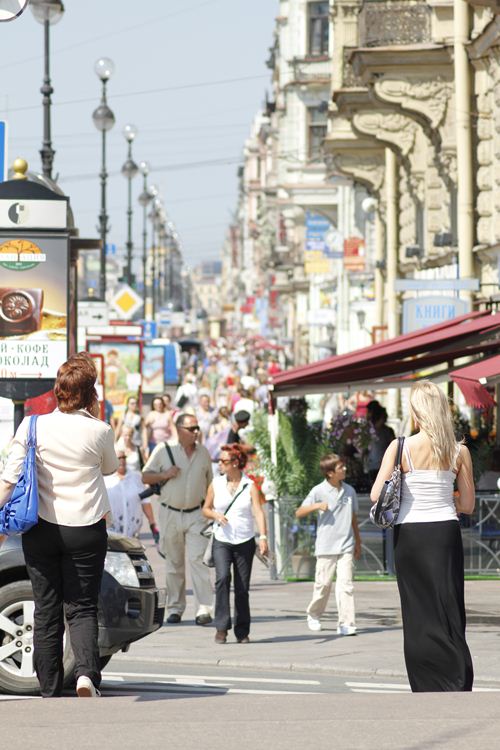
Three and a half hour passed the departure, we arrived St. Petersburg, the cultural and historical capital of geographically largest nation. As we always do, we located lockers to leave our backpacks during the day, but with no English instruction. We asked a few people but no one spoke English. And so our actual journey begins. The 4th largest by population, the city loved by and inspired Russia's great artists, writers, and composers such as Dostoevsky and Chaikovsky. My first impression; European-style architecture surrounding open squares with large fountains, appeared to be a common atmosphere here.
We decided to first situate ourselves, but being illiterate, we looked for a cafe with a picture of a coffee cup. Hmm...КАФЕ...is this it? It took us some time and a whole lot of imagination to see РЕСТОРАН and be able to read restaurant out of it, but we decoded their alphabet by finding words we are familiar with. For example, we saw МАРКЕТ and it appeared to be a market, so Р is R. ВАНК is bank, so H is N, and so on. It is possible to guess some things but i would never know how ЕШИОКА ЕШИТО can be my name.
We walked around all day, which was the best way to see the city, but since it was our first day to experience summer weather of over 30 degrees, or 85F, we were comfortably tired NY the end of the day. At night, we were invited by a local girl whom we met in Iceland, for more walk. The city appeared differently at this hour with building lit, especially temples which had majestic atmosphere. The main reason she brought us out at this hour is the opening of **** bridges over rivers and canals all over the city. At first, I was questioning what might be so special about it, but I was amazed by the number of people out by canalside, guys drinking and girls striking bizzare pose to take portraits. We ended up walking around for 3 hours, and slept in the next day.
7.06.2011
Beer in Finland
I accidentally erased all information, so I will only post images. Honestly, Finnish beer was not as impressive as I had expected. My expectation rose when I learned from more than one Finn that Finland has best water in the world, but I guess you will need more than water to make a good brew.
Deep in Lapland Forest...
We planned to meet up with Jessica at McDonald's, a common spot for Americans to rendez-vous in a foreign land, as not only easy to spot but also having free wi-fi let's us connect and contact while waiting. She arrives right on time, and we realized how nice and comforting to see a friend while far away from everything.
While strolling around town and having lunch, we asked her about filming, and she expressed the difficulty of shooting for this project. Not only having a language barrier, apparently Finnish people especially men, are reserved by nature and so she rarely receives any explanation, or a lending hand. They are warm-hearted people at heart, she added, they just do not express it the same way and same gesture we do. Then, she asked us if we wanted to come stay in her cabin, whether or not being able to see the herding. Without a pause, we nodded with unhidden, excited expression.
Her cabin, located about 2 hours north of Rovaniemi, is on an outskirt of a small town. Our conversation continued to never have a pause on the drive there; it seems we all missed the game of verbal ping-pong. The cabin was large enough to have us, and the sauna outside added an extra treat to this visit. We have been told by many that Finns are fond of sauna but never had a chance to take one during our 2-week stay, even though there is a sauna for every three people in the country. Not only they steam inside, they wash their body, and in winter people take a dip into a frozen lake to cool off. Since the herders had no luck finding a herd that night, we cooked, wined, talked, steamed, and relaxed into the bright night.
Jessica received a message in late afternoon of the following day, that herders have spotted a group, possibly big enough for a shoot. Herders also okayed Sahe and I to come along, so we packed sandwiches and headed for the site. There are many caravans situated at the camp, but most herders were still out. After waiting for a couple of hours, a dozen of leather-jacketed, tanned men on mud-covered ATVs arrive for a break. Apparently, they have rounded up a small herd of about 100 reindeers, and will be chasing them into the fenced area to later match calves with mothers.
After a break, we were allowed to come along with herders to go around the forest behind the herd, to chase them into the fence. Reindeers, usually running around freely with least barriers, are easily frightened by any noise or movement. Chasing the herd is done in a primitive style, with a group of people including families of herders, spread out waving and making sound until reindeers are forced into smaller area.
This experience, having a chance to peek into the lifestyle of people, living side by side with the great nature of Lapland under extreme climate conditions, was nothing like we have seen, done, nor expected. For our journey of northern Europe, began a month and a half ago with a volcano eruption and an end-of-May blizzard, this was such a special, and perfect moment to cap off the first chapter.
While strolling around town and having lunch, we asked her about filming, and she expressed the difficulty of shooting for this project. Not only having a language barrier, apparently Finnish people especially men, are reserved by nature and so she rarely receives any explanation, or a lending hand. They are warm-hearted people at heart, she added, they just do not express it the same way and same gesture we do. Then, she asked us if we wanted to come stay in her cabin, whether or not being able to see the herding. Without a pause, we nodded with unhidden, excited expression.
Her cabin, located about 2 hours north of Rovaniemi, is on an outskirt of a small town. Our conversation continued to never have a pause on the drive there; it seems we all missed the game of verbal ping-pong. The cabin was large enough to have us, and the sauna outside added an extra treat to this visit. We have been told by many that Finns are fond of sauna but never had a chance to take one during our 2-week stay, even though there is a sauna for every three people in the country. Not only they steam inside, they wash their body, and in winter people take a dip into a frozen lake to cool off. Since the herders had no luck finding a herd that night, we cooked, wined, talked, steamed, and relaxed into the bright night.
Jessica received a message in late afternoon of the following day, that herders have spotted a group, possibly big enough for a shoot. Herders also okayed Sahe and I to come along, so we packed sandwiches and headed for the site. There are many caravans situated at the camp, but most herders were still out. After waiting for a couple of hours, a dozen of leather-jacketed, tanned men on mud-covered ATVs arrive for a break. Apparently, they have rounded up a small herd of about 100 reindeers, and will be chasing them into the fenced area to later match calves with mothers.
After a break, we were allowed to come along with herders to go around the forest behind the herd, to chase them into the fence. Reindeers, usually running around freely with least barriers, are easily frightened by any noise or movement. Chasing the herd is done in a primitive style, with a group of people including families of herders, spread out waving and making sound until reindeers are forced into smaller area.
This experience, having a chance to peek into the lifestyle of people, living side by side with the great nature of Lapland under extreme climate conditions, was nothing like we have seen, done, nor expected. For our journey of northern Europe, began a month and a half ago with a volcano eruption and an end-of-May blizzard, this was such a special, and perfect moment to cap off the first chapter.
| For more information about Jessica's film, please click here |
登録:
投稿 (Atom)